memory@gobeyond.net
1 / 2

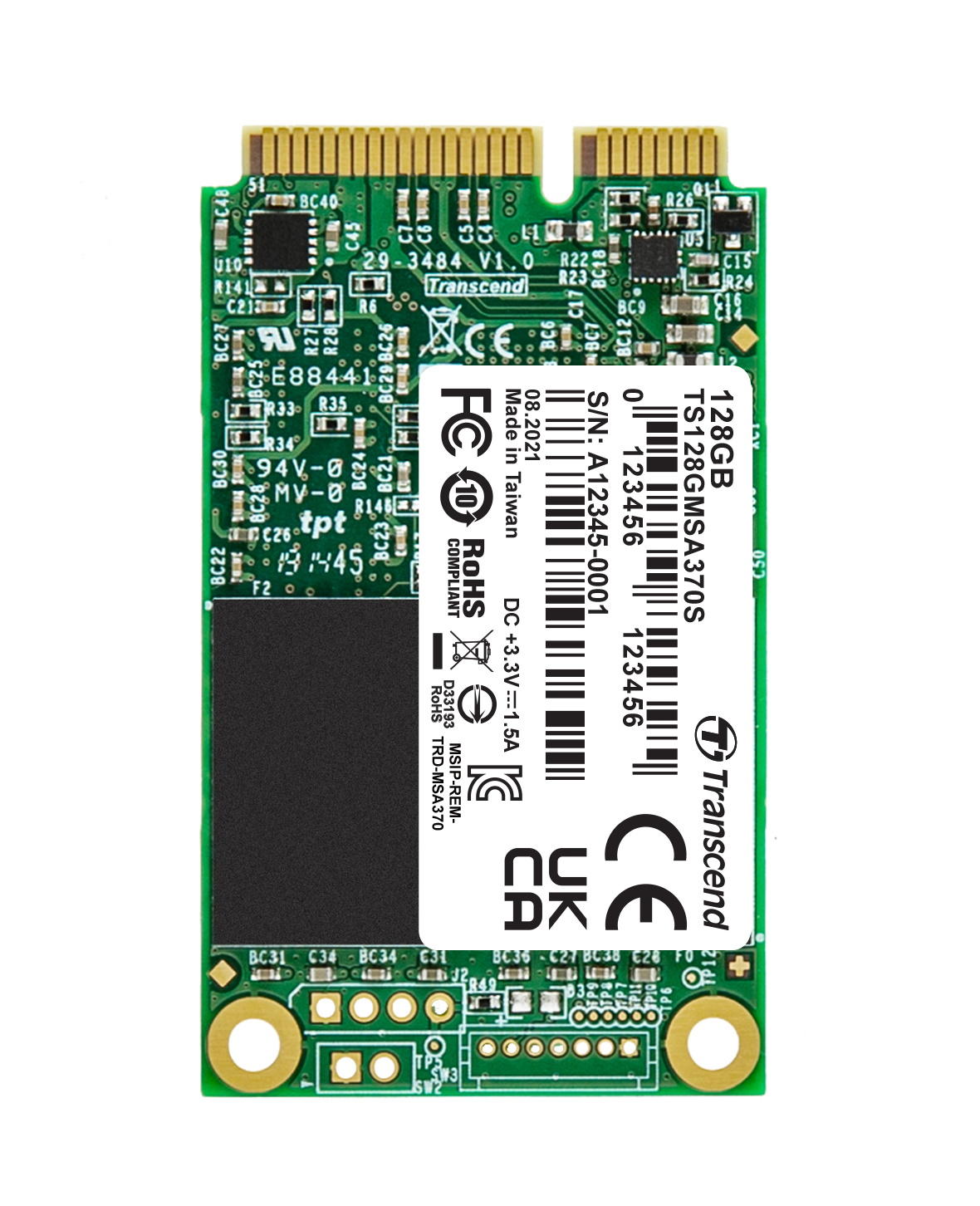
128GB Transcend mSATA SSD 370S Solid State Disk MLC SATA III 6Gbps

Manufactured by: Transcend

Product Information

Part Number: TS128GMSA370S
Item No: 17058
Shipping Weight: 0.1 kgs (0.22 lbs)
Actual Weight: 0.03 kgs (0.06 lbs)

Specifications

CAPACITY
128GB
INTERFACE TYPE
mSATA (PCI Express Mini Card Connector)
FORM FACTOR
50mm mSATA
DEVICE TYPE
SSD Solid State Disk
DATA TRANSFER RATES
Read speed up to 530MB/sec
Write speed up to 200MB/sec
RANDOM READ (4K) IOPS
Random read (4KB): 70000 IOPS
RANDOM WRITE (4K) IOPS
Random write (4KB): 50000 IOPS
FLASH STORAGE DETAILS
MLC NAND Flash
OPERATING TEMPERATURE
0°C(32°F) to 70°C(158°F)
TRIM SUPPORT
Yes
S.M.A.R.T. SUPPORT
Yes
SPECIAL FEATURES
S.M.A.R.T., TRIM and NCQ support
Built-in ECC
DDR3 DRAM Cache
Intel® Smart Response Technology (ISRT) support
SYSTEM REQUIREMENTS
Windows XP/Vista/7/8/10
Linux Kernel 2.6.31, or later
Mac OS 10.4 or later
Embedded systems: WinXP Embedded, WinCE
DIMENSIONS
50.8mm x 29.85mm x 4.85mm
WEIGHT
8g (0.28 oz)
PACKAGING
Retail packaging
WARRANTY
3 years manufacturers warranty

Product Description

The Transcend 370S Series of mSATA SSDs offers a great combination of excellent performance and affordability. Suitable for many ultrabooks, notebooks, tablets, and other devices, the 370S is an ideal upgrade when you are looking to boost performance and add more storage. Supports high transfer speeds and is bult for durability.

Supporting the next-generation Serial ATA interface and built around a powerful controller, Transcend's SATA III 6Gb/s mSATA SSD 370S delivers blazing fast performance and long-term reliability. The compact mSATA form factor makes it perfect for use in space-restricted portable devices such as Ultrabooks, tablet PCs, and slim servers.

Features
- MLC flash-based performance and reliability
- DDR3 DRAM cache
- Maximizes notebook battery life when not in use thanks to full support of SATA Device Sleep Mode (DevSleep)
- S.M.A.R.T., TRIM and NCQ support to maintain a healthy, efficient SSD
- Built-in wear-leveling algorithm ensures highly reliable of data transfer